
Dreading the Call from the Principal? Ways to Set Your Child Up for Success
“This is Principal Jones calling to talk about Johnny’s behavior…”
For many parents, hearing those words is one of the biggest fears that comes with a new school year. If you’ve ever felt anxious about sending your child back to school because of their behavior, you’re not alone. A nationwide study found that nearly one in four parents report concerns about their child’s behavior, with even higher rates among children with developmental, learning, or behavioral differences.
While no parent can eliminate every challenge, there are practical steps you can take to help your child (and yourself) start the school year with confidence.
Remember: You Are Not Your Child’s Behavior
When a child struggles behaviorally, it’s easy to feel like you’re failing. The truth is, your child’s behavioris not a report card on your parenting.
Your role is to teach skills, provide clear expectations, create supportive routines, and respond consistently. Your child is still learning and will make both good and poor choices. What matters is that you’re giving them the tools they need to make better decisions over time.
Be Proactive, Not Reactive
Many parents immediately think about consequences when challenging behaviors occur. Consequences have their place, but they’re only one piece of the puzzle.
If we’re constantly looking for mistakes, we often miss opportunities to notice what’s going well. Instead of waiting to correct unwanted behavior, spend more time teaching the behaviors you want to see and recognizing them when they happen. Children are much more likely to repeat behaviors that receive positive attention.

Teach Expectations Like Any Other Skill
One of my favorite sayings is, “Conflict is often the result of unmet expectations.”
Rather than assuming children know what’s expected, teach those expectations clearly.
Here are four simple ways to make your instructions more effective:
- Get their attention first. Move closer, say their name, and minimize distractions before giving directions.
- Tell them what to do instead of what not to do. Instead of “Don’t hit your brother,” try “Keep your hands to yourself.”
- Make statements instead of questions. “Please put the blocks away” is clearer than “Can you clean up?” of “Clean up, ok?” Questions can unintentionally sound optional.
- Keep it simple. Give one or two directions at a time rather than a long list of tasks. Instead of, “Hang up your backpack, empty your lunchbox, wash your hands, get a snack, and start your homework.” Try: “Hang up your backpack and empty your lunchbox.” Once those are finished, give the next instruction.
Clear instructions increase the chances that children will be successful.
Catch Your Child Being ‘Good’
One of the most powerful parenting tools is simply noticing when your child does the right thing.
Instead of a general, “Good job,” be specific: “Thank you for putting your shoes on the first time I asked,” or, “I noticed you started your homework right away.”
Children repeat behaviors that work for them. When appropriate behavior consistently earns positive attention, it becomes much more likely to happen again.

Every behavior serves a function.
A child may be trying to gain attention, obtain a preferred item or activity, escape or avoid a demand, or meet a sensory need. Understanding the function of the behavior helps us teach a more appropriate way for the child to meet that same need.
Before reacting, ask yourself, “What is my child trying to accomplish with this behavior?”
Understanding why a behavior occurs often leads to more effective solutions than simply punishing it.
Make Mornings Easier
Morning routines can set the tone for the entire day. A little preparation can reduce stress for everyone.
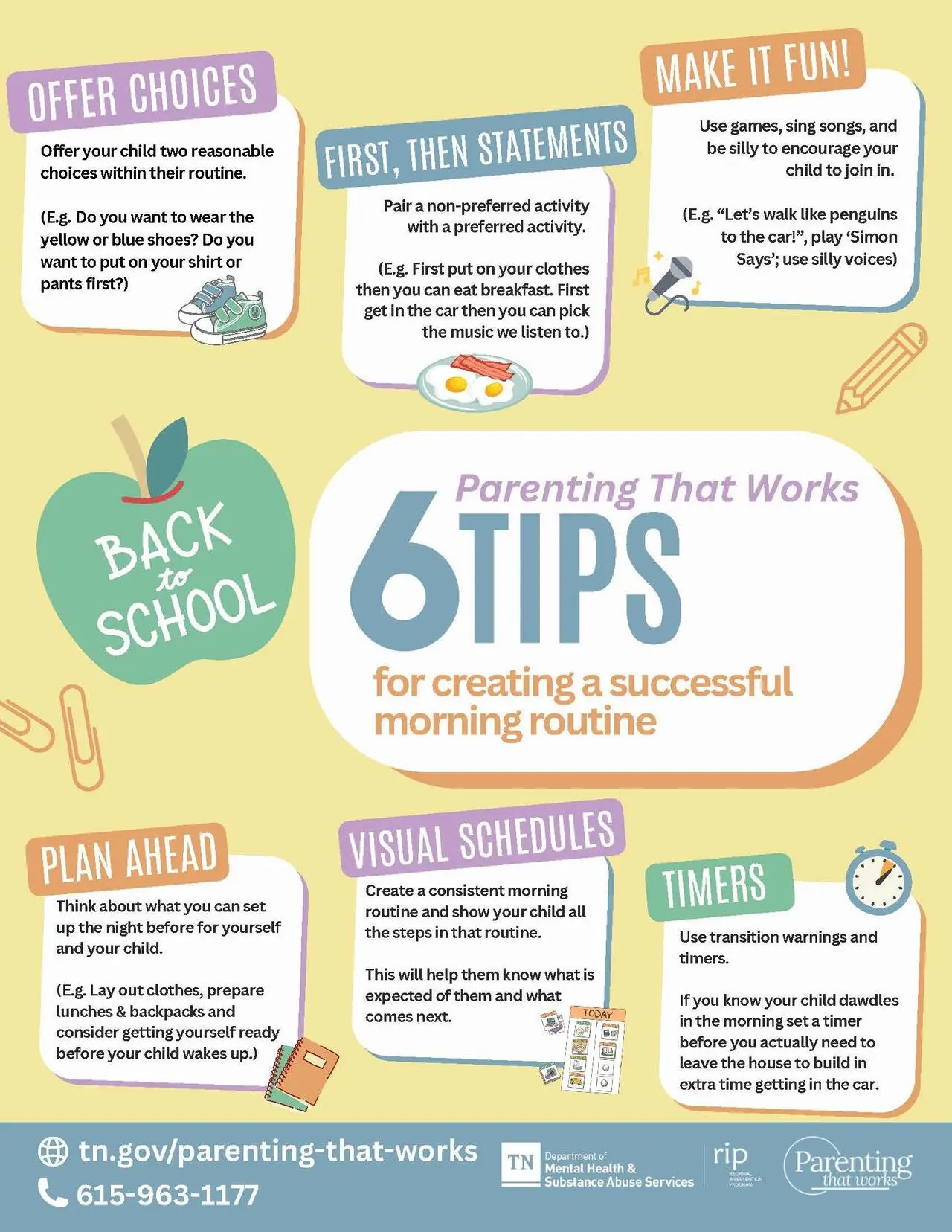
Try these simple strategies:
- Offer simple choices (“Blue shirt or red shirt?”)
- Use “When, Then” statements (“When you get dressed, then you can choose the music.”)
- Make routines fun with songs, games, or silly challenges.
- Prepare clothes, lunches, and backpacks the night before.
- Use a visual schedule so children know what comes next.
- Give transition warnings or use timers to keep everyone on track.
These strategies create predictability, helping children feel more confident and cooperative.
Every Child Can Learn
Children aren’t born knowing how to follow directions, manage emotions, or solve problems appropriately. These are skills that develop through teaching, practice, and encouragement.
As you head into the new school year, remember that perfection isn’t the goal. Consistency, patience, and connection matter far more. Celebrate small successes, keep teaching the behaviors you want to see, and give yourself the same grace you’re giving your child.
If your child is between the ages of 2 and 6 and you’re looking for additional support with challenging behavior, Parenting That Works (Regional Intervention Program) at the University of Memphis offers evidence-based parent training at no cost to families. We work alongside parents to build practical strategies that strengthen relationships, improve behavior, and help children succeed at home, at school, and beyond.
Jenny Davis is a licensed educator with a master’s degree, a mother of four, and the Program Coordinator for the Parenting That Works/Regional Intervention Program at the University of Memphis. She enjoys helping parents navigate everyday challenges using practical, evidence-based strategies that strengthen family relationships and help children thrive. She is also a doctoral student in Educational Psychology and Research at the University of Memphis, where her research focuses on improving families’ access to and engagement in evidence-based parenting programs.